

How to vote
Summary
Find out how to vote in four simple steps, from the moment you arrive at the polling station to the moment you place your ballot in the ballot box.
To vote, you must be registered on the list of electors. Most electors are already properly registered at their domicile address and do not need to take any action. To make sure, check your registration . On election day, you will not be able to register or change your address.
ELECTION UNDERWAY
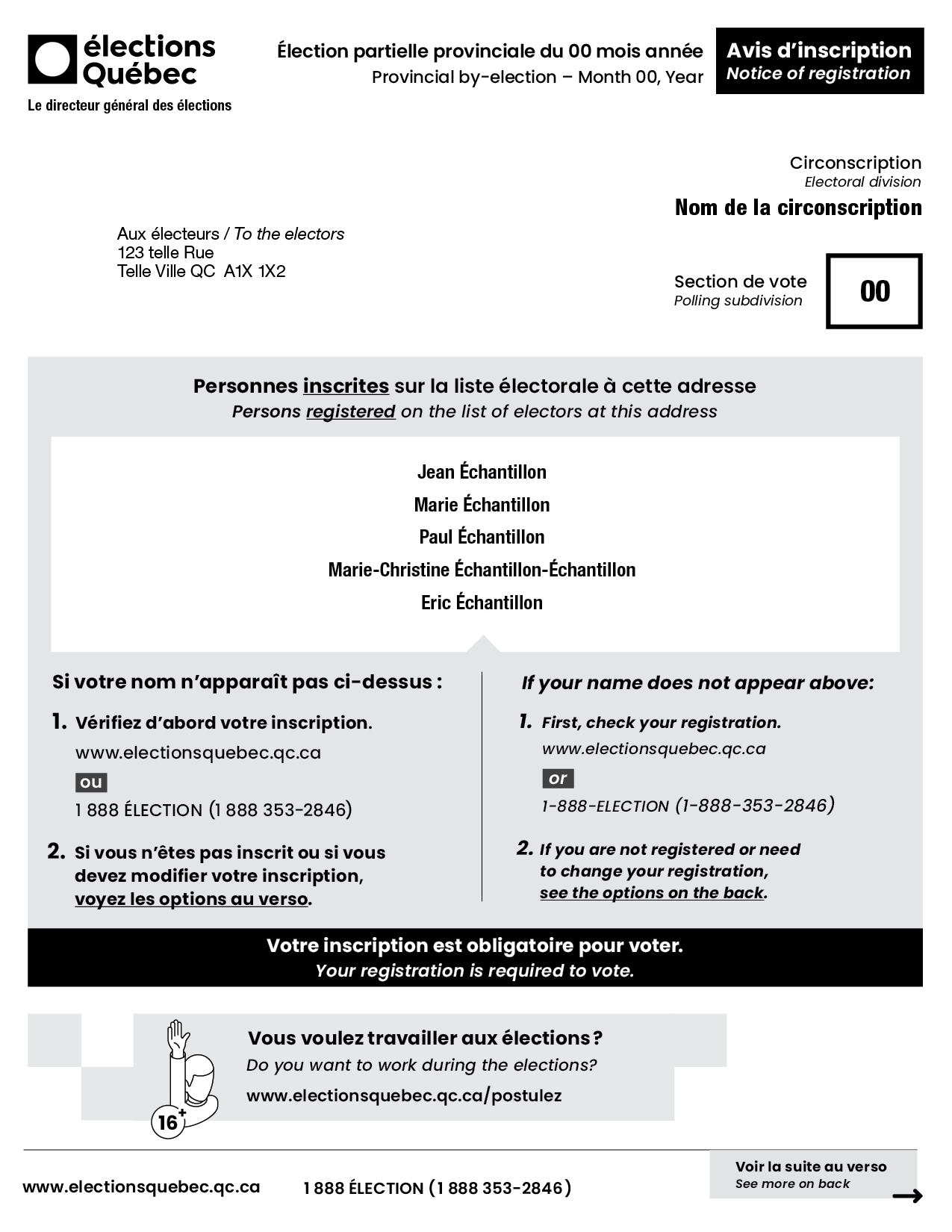
Your name must be on the list of electors in order for you to vote. Check that your name is listed online, or on your notice of entry. If your name is not listed, or if you find an error, you can fix it now, you have until 2 p.m. [jour -4] to rectify the situation. After that, it will be too late!
Preparation
You may bring the notice of entry or the yellow reminder card you received in the mail. It’s not mandatory, but it helps election officers direct you to the right place more quickly. However, make sure to bring one of the accepted identification documents.
Steps in the voting process
The following video (in French) will help you understand how to vote. It explains the four important steps in the voting process. You can also browse through the steps in the carousel below.
Video
The video is in French, but English subtitles are available.
Carousel
Vote as a family!
Don't hesitate to bring your children along: they will be able to vote at the small polling station set up especially for them.
Need help to vote?
Election officers will be able to help if you have special needs.
ELECTION UNDERWAY
To vote, you must be registered on the list of electors. Most electors are already properly registered at their domicile address and do not need to take any action. To make sure, check your registration. On election day, you will not be able to register or change your address.
Preparation
You can bring the notice of entry or the reminder card you received in the mail. It’s not mandatory, but it helps election officers direct you to the right place more quickly. However, make sure to bring one of the accepted identification documents.
Steps in the voting process
The following video (in French) will help you understand how to vote. It explains the four important steps in the voting process. You can also browse through the steps in the carousel below.
Video
The video is in French, but English subtitles are available.
Carousel
More than one ballot
In a municipal election, you may have to fill out up to eight ballot papers.
In Québec municipalities divided into electoral districts, electors cast ballots for the position of councillor in their district and for the position of mayor. They must therefore fill out two ballot papers.
In municipalities whose territory is not divided, electors vote for each councillor position as well as for the mayor. Generally, there are six councillors in these municipalities. In some municipalities with fewer than 2,000 inhabitants, there are four.
Some electors also vote for the regional county municipality (RCM) warden.
Sometimes, people are elected unopposed; in this case, there are fewer positions up for election.
Need help to vote?
Election officers will be able to help if you have special needs.
ELECTION UNDERWAY
To vote, you must be registered on the list of electors. If you didn’t receive any notice of entry or reminder card, make sure your name is on the list of electors. On election day, you will not be able to register or change your address.
Preparation
You can bring the notice of entry or the reminder card you received in the mail. It’s not mandatory, but it helps election officers direct you to the right place more quickly. However, make sure to bring one of the accepted identification documents.
Steps in the voting process
The following video (in French) will help you understand how to vote. It explains the four important steps in the voting process. You can also browse through the steps in the carousel below.
Video
The video is in French, but English subtitles are available.
Carousel
Need help to vote?
Election officers will be able to help if you have special needs.
More than one ballot
In a school board election, you may have to fill out up to two ballot papers.
You must vote for the position of chairperson of the school board and for the position of commissioner for the district in which your domicile is located.
Sometimes, people are elected unopposed; in this case, there are fewer positions up for election, and therefore fewer ballots.