

Selection of Polling Locations
Summary
Accessibility and proximity are the two main criteria that guide the selection of polling locations. On the one hand, all electors must be able to access their polling location without difficulty. On the other hand, their polling station must be located close to their domicile. On election day, there are more than 4,150 polling locations in Québec.
In this section
The returning officer must ensure the accessibility of the building they select. They evaluate various criteria by visiting each location where they plan to offer revision and voting services to the electorate. They must identify potential issues and eliminate any barriers faced by electors.
For a location to be considered accessible, it must meet all *mandatory criteria*. If only one of the mandatory criteria is not met, the location cannot be considered accessible.
You can check whether your polling place is accessible on election day on the page Where and when to vote If your polling place does not meet your needs, contact your returning officer. You will be able to obtain permission to vote at another accessible polling place in your electoral division.
Parking
- A parking area has been reserved for persons with disabilities.
- This parking space is located near the entrance
- It has a solid surface that is passable for a wheelchair
- It is clearly designated by adequate signage
- It has a regulatory dimension of 3.9 m (12 ft 10 in.) by 6 m (19 ft 8 in.)
Outdoor Path
- The path width is at least 91.5 cm (36 in.) *mandatory criterion*
- The surface is firm, stable, and passable for a person in a wheelchair *mandatory criterion*
- If the distance is 12 m (39 ft) or less, the maximum slope is 6 degrees (1:10); if the distance is more than 12 m (39 ft), the maximum slope is 5 degrees (1:12) *mandatory criterion*
Signage
- The path to the polling location is clearly marked from the public road
Building Access
The location offers level access. If the location does not offer level access, it is accessible by elevator or platform lift, or via a compliant access ramp.
The elevator and platform lift must meet certain criteria:
- Door width
- If the platform entry and exit are direct (in a straight line), the width is at least 77.5 cm (30.5 in.) *mandatory criterion*
- If turning is required to enter and exit the platform, the width is at least 80 cm (31.5 in.) *mandatory criterion*
- Depth
- If the platform entry and exit are direct (in a straight line), the depth is at least 1.2 m (48 in.) *mandatory criterion*
- If turning is required to enter and exit the platform, the depth is at least 1.5 m (60 in.) *mandatory criterion*
The access ramp must meet certain criteria:
- The ramp width is at least 86.4 cm (34 in.) between the handrails *mandatory criterion*
- The maximum ramp slope is 6 degrees (1:10) *mandatory criterion*
- The top and bottom landings of the ramp measure at least 1.5 m by 1.5 m (60 in. by 60 in.) or are configured so that access to the ramp and entrance door is unobstructed *mandatory criterion*
- If the intermediate landing is in a straight line, it measures at least 1.2 m (48 in.) in depth and 86.4 cm (34 in.) in width *mandatory criterion*
- If the intermediate landing turns at 90 degrees, it measures at least 1.2 m (48 in.) in depth and 1.2 m (48 in.) in width *mandatory criterion*
- If the intermediate landing turns at 180 degrees, it measures at least 1.74 m (68.5 in.) in depth and 1.2 m (48 in.) in width *mandatory criterion*
- The ramp is passable and safe for a wheelchair *mandatory criterion*
The elevation of the ramp has an impact on the security measures to be implemented:
- No modifications are required for a ramp less than 20.3 cm (8 in.) high
- A curb (wheel guard or wheel stop) is required for any ramp that rises between 20.3 cm (8 in.) and 61 cm (24 in.) *mandatory criterion*
- A safety guardrail is required for any ramp that rises more than 61 cm (24 in.) *mandatory criterion*
Doors
- When the door is open at 90 degrees, the clear opening is at least 77.5 cm (30.5 in.) *mandatory criterion*
- The maximum threshold height is 1.3 cm (0.5 in.) *mandatory criterion*
- The maximum threshold slope is 7 degrees (1:8) *mandatory criterion*
- The exterior entrance door opens automatically or is attended at all times by a staff member; interior doors open automatically or are kept open at all times during voting days (if this is not possible, a staff member attends the interior doors) *mandatory criterion*
Path Inside the Building
- Minimum corridor width of 91.5 cm (36 in.) *mandatory criterion*
- Maximum interior travel distance of 30 m (98.5 ft)
Restrooms
- Clearly indicated restroom location
- Minimum restroom door opening or clear width of 77.5 cm (30.5 in.)
- The maneuvering clearance is at least 1.5 m (60 in.)
- A grab bar is available beside the toilet
- An open space is provided beside the toilet
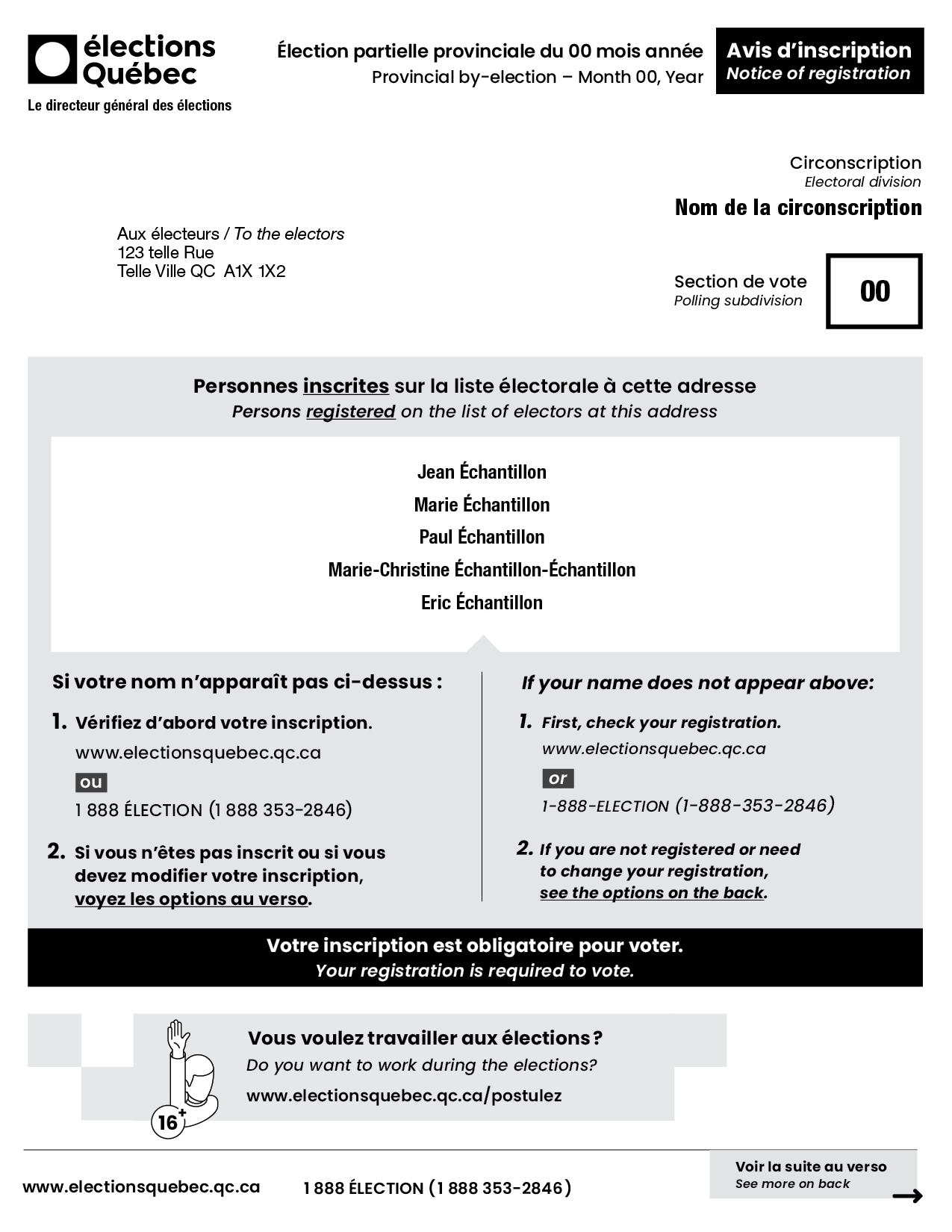
Information regarding the accessibility of locations and services offered to the electorate is published on the notice of entry and on the website when searching for a location on the pages below.
If a location is not accessible, an elector may obtain authorization to vote at a different, accessible location within his or her electoral division. For more information, contact your returning officer.
Accessibility is imposed under the Election Act (E-3.3) and the Act to secure handicapped persons in the exercise of their rights with a view to achieving social, school and workplace integration (E-20.1). Accessibility-related assessment criteria are established by Élections Québec in collaboration with Société Logique.
Proximity
Returning officers must take into account the size of polling locations. Each location can accommodate a maximum number of polling stations, and therefore a maximum number of staff members and electors. When a location’s capacity is reached, some electors domiciled nearby may sometimes have to go farther to vote.
The Election Act provides that the use of premises belonging to municipalities and school service centres is free of charge. For this reason, premises located in schools and community centres are preferred. Other polling locations are in public places where a room is available, such as a hotel or a vacant or unused commercial space.