

Main steps of an election period
Summary
Each election period includes key moments that allow electors to run as candidates, apply to work in elections, verify their entry on the list of electors, and vote.
Provincial general elections are generally held every four years, on the first Monday in October. However, early elections may be called before that date, particularly when the government holds a minority in the Assemblée nationale.
The Chief Electoral Officer is the person designated by the Assemblée nationale to organize and hold provincial elections. The Chief Electoral Officer is neutral and impartial.
General elections make it possible to elect a Member of the Assemblée nationale in each of Québec’s 127 electoral divisions. Those elected represent the electors at the Assemblée nationale.
Calling of general elections and by-elections
Elections are called by an order, which is a written decision issued by the executive branch, namely the Gouvernement du Québec. When the time comes to hold a provincial general election or a by-election to fill a vacant seat in the Assemblée nationale, an order triggers the election period. This period lasts between 33 and 39 days.
A by-election must be called when a Member’s seat in an electoral division becomes vacant due to their death or resignation, for example. The government must call an election within six months of such an event. It does not need to call a by-election if the seat becomes vacant six months or less before the scheduled date of a general election.
Provincial general elections, step by step
Dissolution of the Assemblée nationale
Since 2013, the Election Act provides that provincial general elections are held on a fixed date. The Assemblée nationale is dissolved on August 29th of the fourth year following the last general election. However, the premier can ask the lieutenant governor to dissolve the Assemblée nationale before the end of the Legislature, which normally lasts four years. The dissolution of the Assemblée nationale ends the Members’ term, which triggers a general election.
Start of the election period
Under the rules governing the control of election expenses, the election period starts the day after the order instituting the election is issued. It ends on polling day, when polling places close.
Organization of polling places and electoral work
After the election order is issued, the returning officers open their main office to the public and prepare for the election in their respective electoral division.
During the election period, Élections Québec mobilizes all the human and material resources needed to allow you to vote. We hire around 60,000 people across Québec! Anyone wishing to work as an election officer can apply online (in French) as the election approaches.
Filing nomination papers
Citizens who decide to run for a political party or as an independent candidate must meet the conditions set out in the Act. For fixed-date general elections, they have until 2:00 p.m. on the 18th day before the election to file their nomination papers. For by-elections or general elections called before the end of the Legislature, they have until 2:00 p.m. on the 16th day before the election to do so.
When the deadline for filing nomination papers ends, the ballot papers are finalized and printed. This step takes place approximately two weeks before the election.
Entry on the list of electors
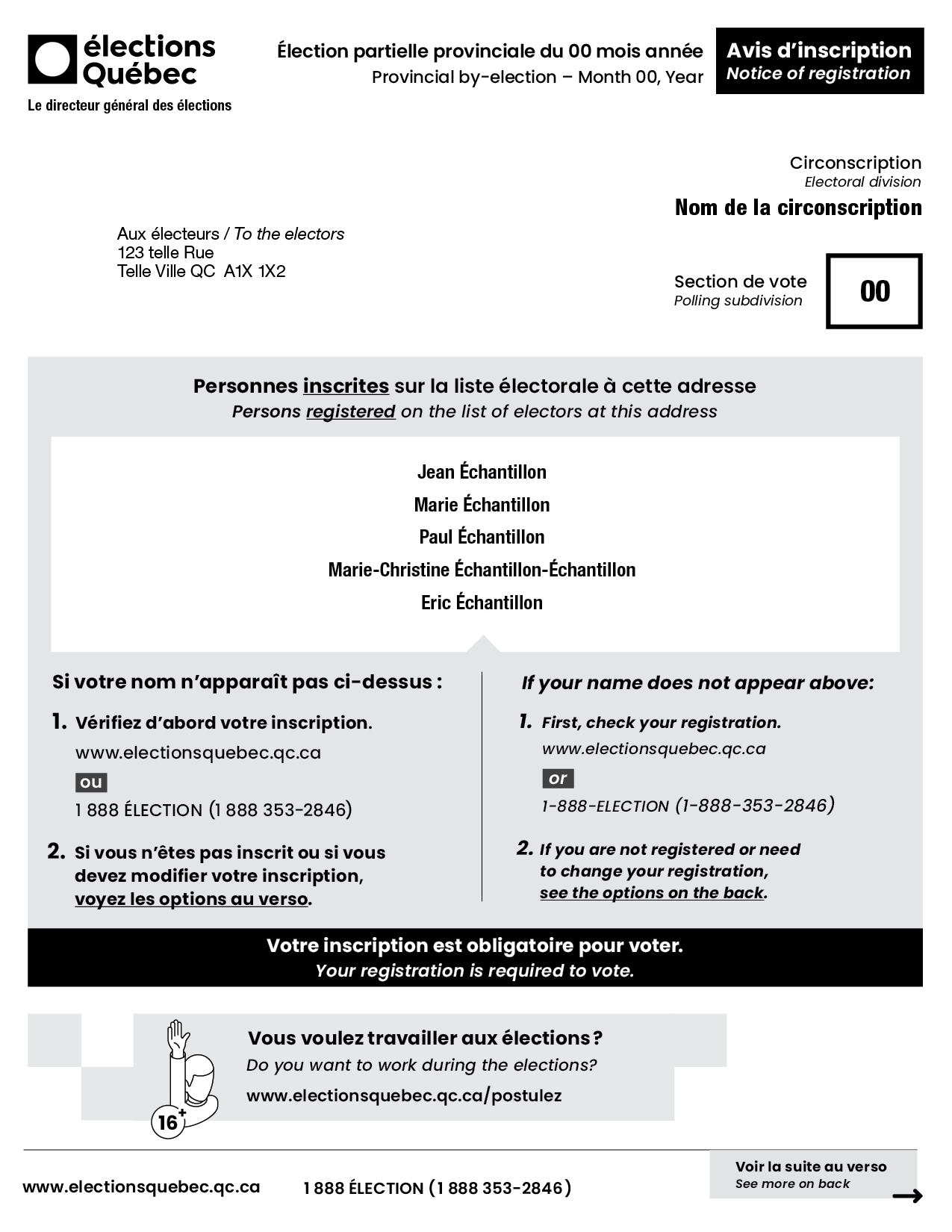
Élections Québec sends a notice of entry by mail to invite all Québec electors to verify that their name is entered on the list of electors at their address. Electors must make sure that their name is entered on this list to be able to vote. They can do so in three ways:
- By checking the notice of entry sent by mail during the election period;
- Online, using the Making sure your name is on the list of electors service;
- By contacting us.
Electors can be entered or modify their entry on the list of electors from the 21st to the 4th day before the election.
Advance polls and other voting options
Electors have access to various voting options, including advance polls and voting at the office of the returning officer between the 10th and 4th day before the election.
Other voting options are available to electors in particular situations, such as voting at home and voting outside Québec.
Receipt of reminder cards
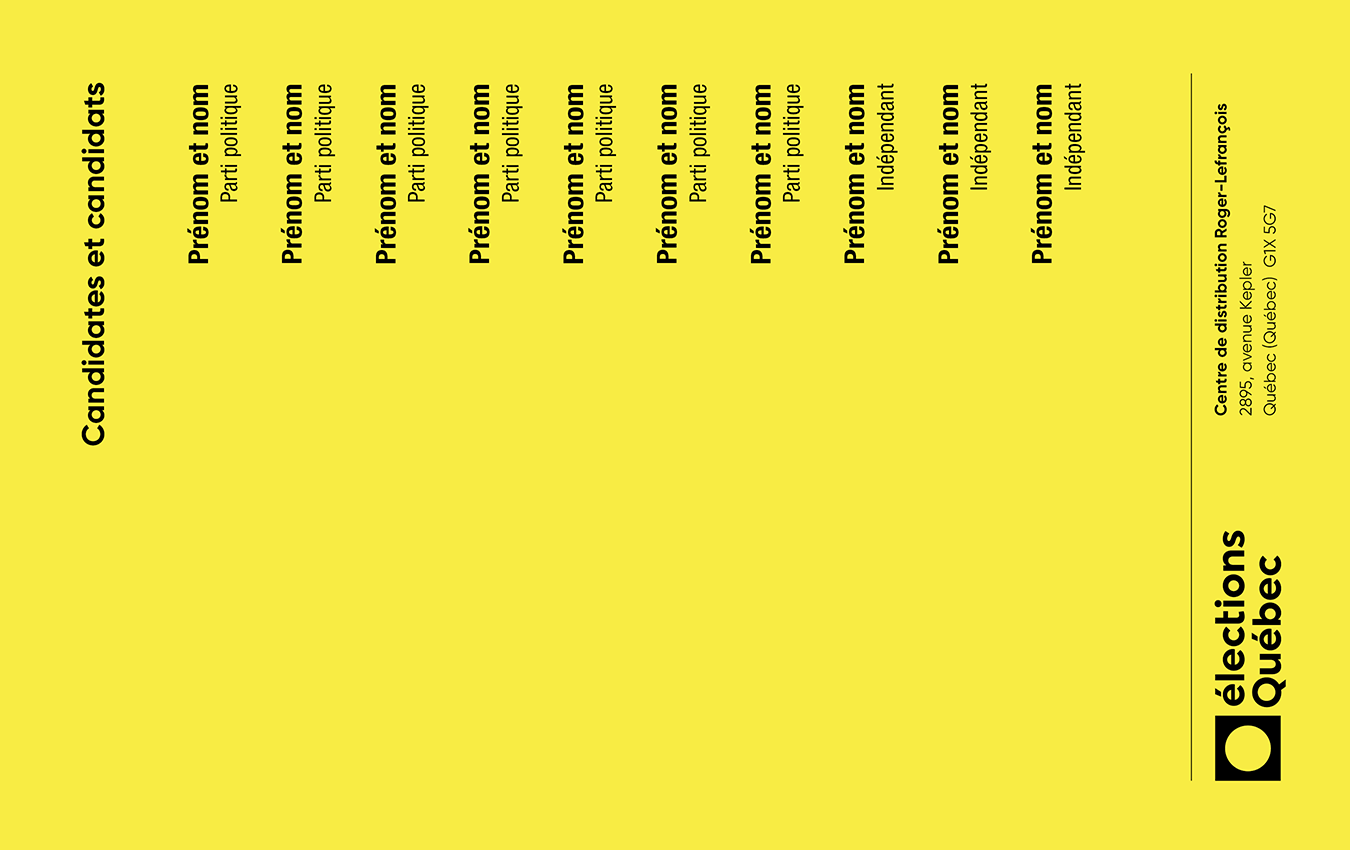
The week before the election, electors receive a reminder card informing them where they will be able to vote on election day. This card also includes the list of candidates running in their electoral division.
Election day
Electors who did not vote earlier can exercise their right to vote on election day. There are more polling stations open on that day.
Election officers greet electors at their polling place and inform them of the proceedings.
Electors must present one of the accepted pieces of identification to be able to vote. They vote behind a polling booth, to keep their vote confidential.
Counting of the votes, addition of the votes, and declaration of election
When the polling stations close, the election officers count all the ballot papers cast in favour of each candidate. Media outlets rely on this process to make projections and predictions, which often lead them to declare certain candidates elected before all the votes have been counted. They may thus announce preliminary results that same evening.
The following day, the addition of the votes is used to validate the results transmitted on election night. The candidate who received the most votes wins the election in their electoral division.
Generally, the results make it very clear who has been elected. Sometimes, the ballot papers need to be recounted during a judicial recount. An application for a judicial recount can be filed with the Court of Québec in the four days following the addition of the votes. After this deadline, or following the judicial recount, the Chief Electoral Officer sends the list of elected members to the Assemblée nationale.
The municipal election period lasts 45 days
- 44 days before the election: official start of the election period.
- 30 days before the election: last day to file a nomination paper.
- Between 22 days and 12 days before the election: period for applying for entry or for amending one’s entry on the list of electors. Please note that the days may vary, so consult your notice of entry or contact your returning officer.
- 7 days before the election: advance polling. In some municipalities, there is more than one day of advance polling. Consult the public notice or ask your returning officer.
- Election day: All electors who have not already done so may vote.
The school election period lasts 45 days
- 44 days before the election: the election period begins
- 35 days before the election: deadline for filing nomination papers
- 19 days before the election: last day to apply for registration or to request a change to the list of electors
- 7 days before the election: advance polling day
- Election day: all electors are invited to vote