

Québec’s electoral systems
Summary
In Québec, electors vote in:
- Federal elections, to form the Government of Canada
- Provincial elections, to form the Government of the province of Québec
- Municipal elections, to elect the mayor and councillors of their municipality
- School board elections, to elect people to sit on the English-language school board’s Council of Commissioners
The role of Members of the National Assembly
Your Member of the National Assembly represents your electoral division in the National Assembly. This person may belong to the political party that forms the government or an opposition party. They may also be independent, which means that they do not belong to any political party.
One of the mandates of MNAs is to study, analyze, and vote on bills. They also act as intermediaries between the people and the government: they ensure that the interests of the population are well protected. As they are aware of the opinions and concerns of their constituents, members can to speak and act on behalf of their community on various issues, for example during debates in the National Assembly.
Representative democracy
Québec's electoral system is representative. Candidates elected in general or by-elections are mandated to make decisions and pass laws on behalf of their electors. In other words, by exercising our right to vote, we have an influence on the election of the person who will represent us.
The province is divided into 125 electoral divisions that make up Québec’s electoral map. An electoral division is a geographical territory. Each electoral division has approximately the same number of electors. The number of electoral divisions corresponds to the number of seats in the National Assembly. Provincial general elections serve to elect the 125 members that make up the National Assembly.
The calling of elections
Provincial general elections are held every four years on the first Monday in October. However, there may be early elections, for example when there is a minority government in the National Assembly.
The Chief Electoral Officer, a neutral and impartial person appointed by the National Assembly, is tasked with organizing and holding provincial elections.
Candidates from different political parties and independent candidates campaign during the election period. Their goal is to make themselves known and present their platform in order to be elected in their electoral division.
You can vote for one of these candidates. The political party that elects the largest number of MNAs forms the government. Their leader becomes Premier. A majority government is formed when it wins more than half of the 125 seats in the National Assembly. If it wins less than half of these 125 seats, it is known as a minority government, and the group that forms the opposition has more seats in total.
Provincial general elections, step by step
- Dissolution of the National Assembly
The Lieutenant-Governor has the power to dissolve the National Assembly on the advice of the Government. When it does so, it terminates the mandate of the MNAs and calls an election. - Preparation of the list of electors
Élections Québec reminds all Québec voters to make sure their name is on the list of electors with their home address. If you wish to vote, you must make sure your name is on this list. You can do this in three ways:- Online, at Check your registration on the list of electors
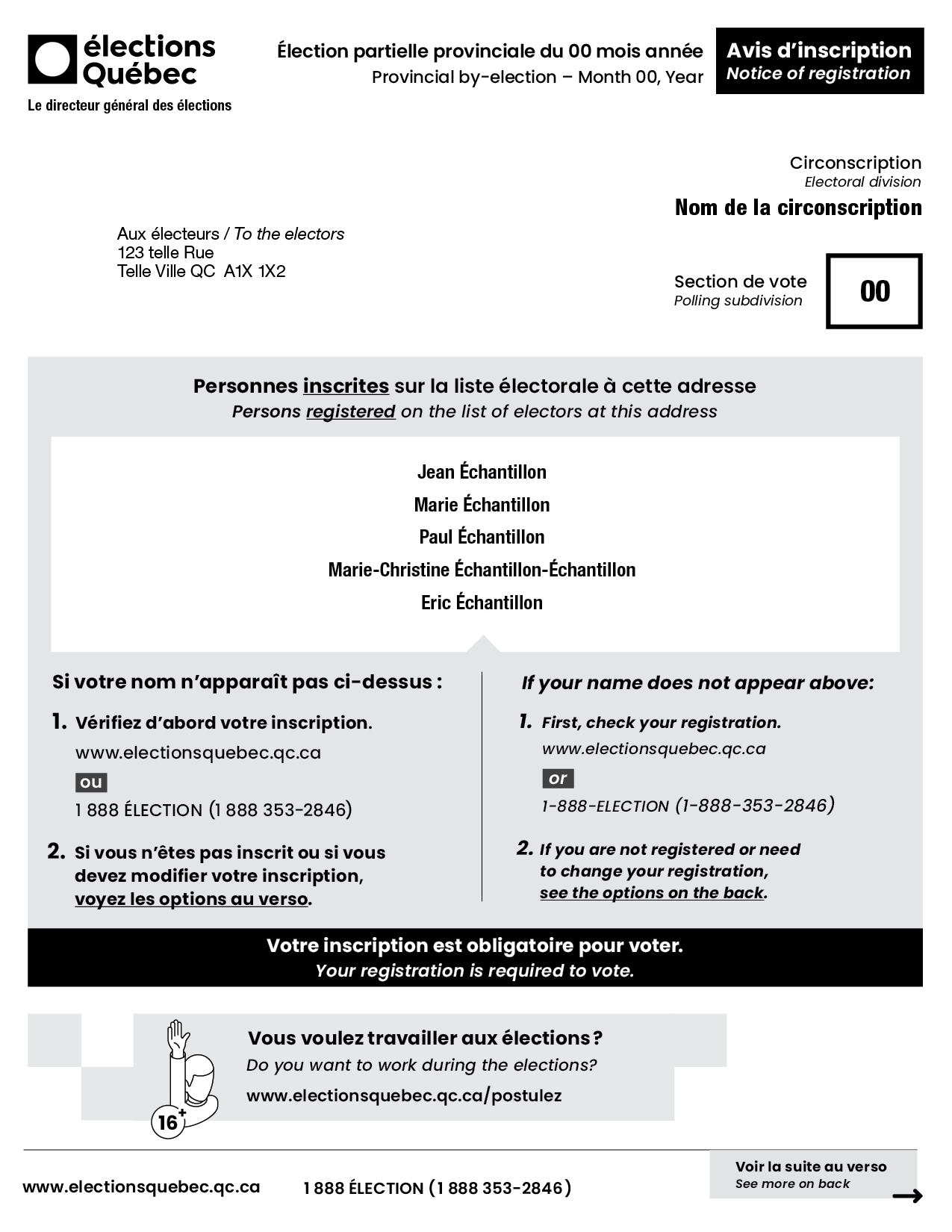
- On the notice of entry you receive in the mail during the election period
- By contacting us
- Filing of nomination papers
Citizens who decide to run for a political party or as an independent candidate must meet certain conditions. They must file nomination papers before the deadline established in the Election Act. - Organization of polling locations
During the election period, Élections Québec deploys all the human and material resources necessary to enable you to vote. We set up approximately 20,000 polling stations across Québec! - Vote
On voting days, election officers are there to greet you and provide instruction. They make sure that you can vote in an accessible place, unencumbered and in a confidential manner. - Counting of the votes and disclosure of results
At the closing of the polls, the election officers count the ballot papers. The next day, the votes are recounted to validate the results or to find any possible errors. The candidate with the most votes wins the election in their electoral division.
Since 2005, all municipalities have held their elections on the first Sunday in November every four years. Between general elections, by-elections may be held when a vacancy occurs.
Roles and responsibilities
Returning officer
Municipal elections are managed locally with returning officers responsible for overseeing the election in their area. Under the Act respecting elections and referendums in municipalities (AERM), this responsibility falls to the municipal clerk or clerk-treasurer. The AERM allows them to exercise authority over an election.
The returning officer provides services to electors and actual or potential candidates. They must ensure the necessary resources and staff are available to carry out all stages of the election. They must also ensure that the vote is conducted properly. Moreover, they are responsible for sharing information about the current election with the media and the public.
Élections Québec
Élections Québec is not directly responsible for municipal elections. However, the Act respecting elections and referendums in municipalities gives it certain responsibilities.
Support
At the request of the returning officer, Élections Québec may provide assistance where necessary. We offer training for municipal returning officers. We provide a set of tools to support them in their role. We also assist them, by telephone, in all matters relating to the application of the provisions of the Act respecting elections and referendums in municipalities.
List of electors
At the start of the election period, we provide an extract from the permanent list of electors to the returning officer. They then prepare the official list of electors for their municipality using this extract.
When the activities of the board of revisors are completed, the returning officer sends us the changes made to the electors residing in the municipality. This data allows us to update the permanent list of electors.
Investigations and prosecutions
The Chief Electoral Officer is responsible for the application of the legal provisions stipulated by the Act respecting elections and referendums in municipalities and prosecuting any violations of electoral procedures or financing. They may investigate based on their own initiative or as a result of a complaint made under the Act.
Information
Élections Québec's information centre will answer any questions from the public concerning municipal political financing. It may also provide general information on other provisions of the Act respecting elections and referendums in municipalities. Electors, candidates and other interested persons should contact their returning officer for any questions related to the election in their municipality.
Ensuring the application of the Act respecting elections and referendums in municipalities with respect to political financing
Élections Québec is responsible for the application of the parts of the Act respecting elections and referendums in municipalities that concern political financing. In municipalities with more than 5,000 inhabitants, Élections Québec is responsible for overseeing the financing of municipal political parties and independent candidates. The auditing of election expenses, including the authorization of political parties and independent candidates, also falls under its authority. Moreover, Élections Québec handles the financing of leadership campaigns for municipal political parties.
In municipalities with fewer than 5,000 inhabitants, Élections Québec oversees the application of the chapter regarding the disclosure of certain contributions and expenses.
Ministry of Municipal Affairs and Housing
The Ministry of Municipal Affairs and Housing is responsible for the administration of the Act respecting elections and referendums in municipalities. It may also propose legislative changes to the National Assembly.