

New citizens
Summary
Have you obtained your Canadian citizenship? You can now prepare to exercise your right to vote in Québec.
In this section
Learning about democracy and the right to vote
Democracy is a political system that allows electors to vote to elect the people who represent them and make decisions on their behalf in government.
In Québec, voting is a fundamental right protected by the Canadian and Québec charters of rights and freedoms.
- Your vote is secret: you do not have to reveal who you voted for, and you put your folded ballot paper in the ballot box yourself.
- Your vote is free: no one can force you to vote for a particular political party or candidate.
- Your vote is an individual choice: spouses can vote independently of each other.
- Your vote is important: it has equal value to that of all other electors.
To learn more, watch the video on representative democracy (in French).
Distinguishing between types of elections
In Québec, electors vote:
- in provincial elections, to form the government of the province of Québec;
- in municipal elections, to elect the mayor and councillors of their municipality.
Some people can also vote in school elections, to elect members of the Council of Commissioners of an English-language school board.
Québec is a neutral and independent institution responsible for organizing provincial elections. We also support the returning officers who organize municipal and school elections. Electoral legislation entrusts us with other mandates, including the application of rules on political financing and election expenses.
To learn more, consult the page Québec’s electoral systems.
Federal elections
Quebecers also have the right to vote in federal elections, to form the Government of Canada. Elections Canada has the same responsibilities as Élections Québec for the federal electoral level, which covers all Canadian provinces and territories.
Responsibilities of governments
When elected, government representatives must make decisions. Their responsibilities vary depending on the type of government. Here are some examples:
Federal government
- Airports
- Immigration and citizenship
- National defence
- Passports
- Postal services
Provincial government
- Social assistance
- Education
- Driver’s licence
- Health care
- Transportation and road network
Municipal administration
- Water supply and sewers
- Libraries
- Garbage collection and recycling
- Police and fire protection services
- Sports and recreation
Exercise the right to vote
Here is what you need to know to exercise your right to vote in a provincial or municipal election. Several pages on our website allow you to find information according to the type of election in progress.
To vote, you must first meet certain conditions, such as:
- be 18 years of age or older on election day;
- be a Canadian citizen;
- have been domiciled in Québec for at least six months.
You must also be entered on the list of electors at your domiciliary address. You are responsible for checking your entry and updating your address, if necessary, before election day.
You can vote on election day and during advance polling. Other options may also be available depending on your situation. For example, during a provincial election, you can register to vote by mail if you are travelling or visiting outside Québec.
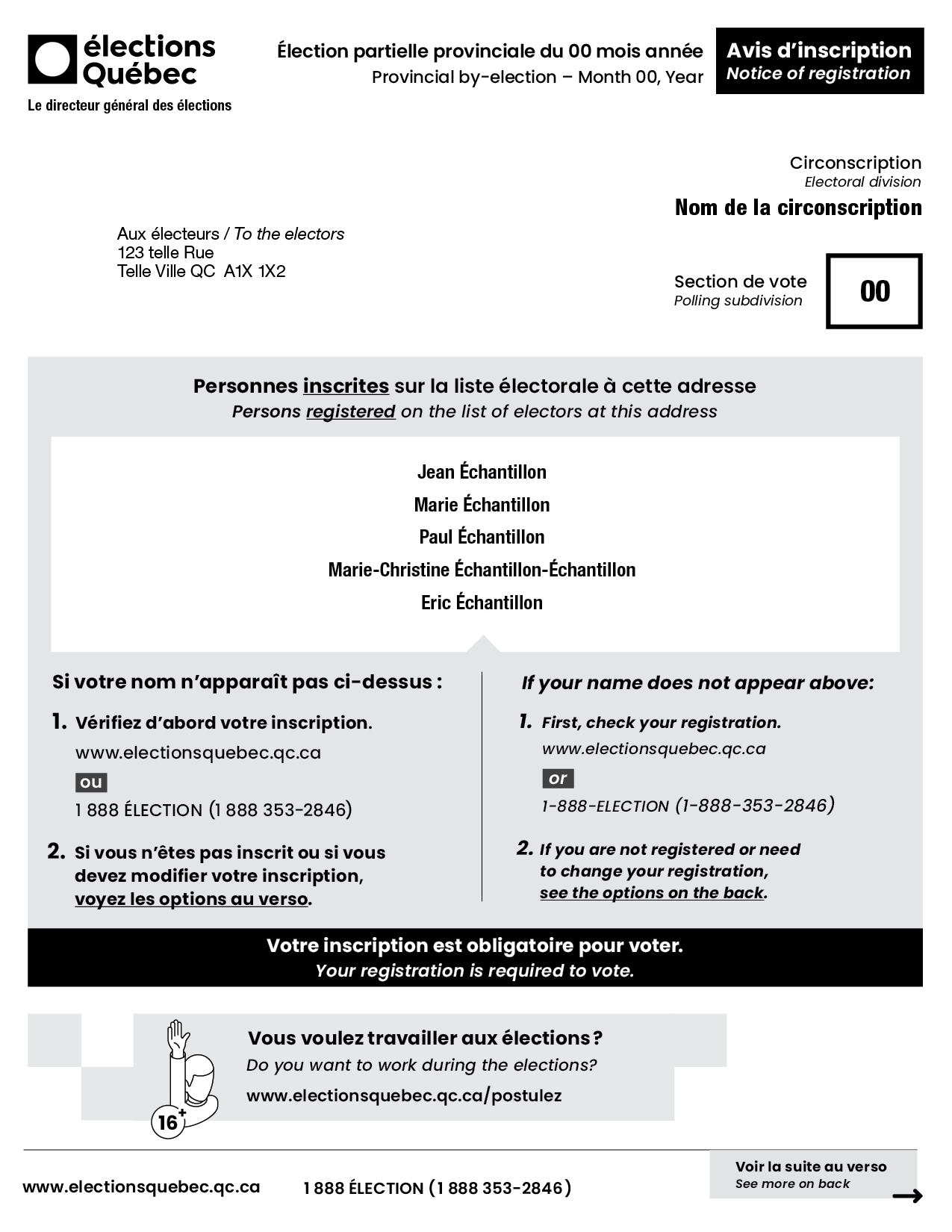
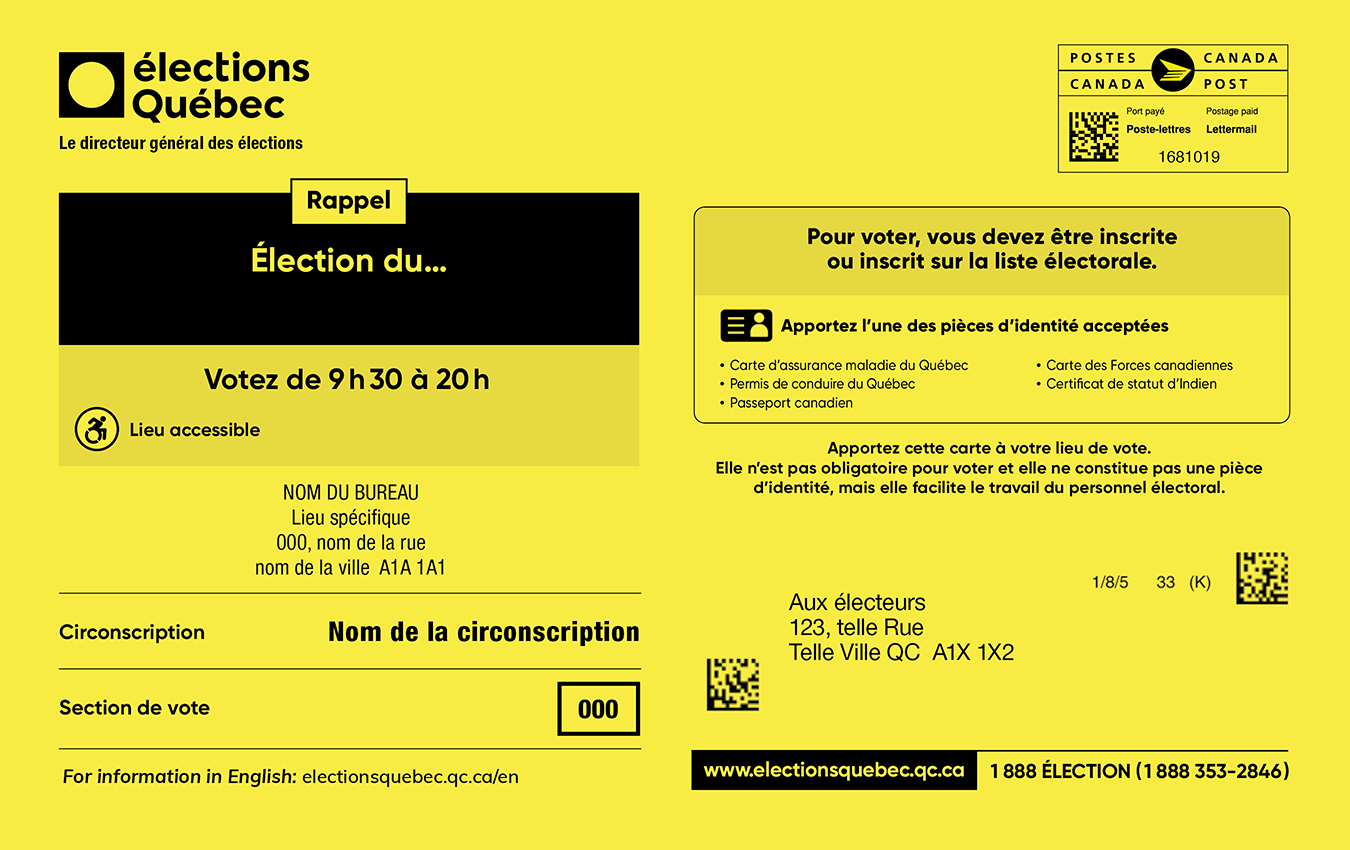
When you go vote, you must bring a piece of identification. You can also bring your notice of entry or your yellow reminder card, but it is not mandatory. You will receive these documents by mail.
Understanding the vote
Voting is a simple action that keeps democracy alive. Discover the steps to follow in the video below or on the How to vote page.
The video is in French, but English subtitles are available.
All reasons are good reasons to vote. Discover why your vote is important and be inspired by quotations from other electors.
Election vocabulary
To help you understand certain terms, consult our election vocabulary (in French).
Finding your electoral division and your candidates
Québec is divided into electoral divisions that form the provincial electoral map. Each electoral division is represented by an MNA (member of the National Assembly) who sits in the Assemblée nationale. This person defends the interests of citizens.
During a provincial election, you must know your electoral division to find out which candidates you can vote for. This information is indicated on the yellow reminder card you receive by mail a few days before the election.
Experiencing democracy
It is never too early to learn about democracy or to take an interest in it. During provincial elections, small polling stations are set up in polling places so that your children can experience voting with you. They can vote by answering a question designed specifically for them. Families are therefore welcome.
The Voting in Québec program provides an introduction to Québec’s election system and the exercise of the right to vote. It is intended for people who receive services from an organization involved in francization, socio-occupational integration or literacy, as well as for those studying at an adult education centre or a vocational training centre. If this applies to you, you may receive an invitation to participate in this program. You can discuss it with the person in charge of the organization or your training centre.
Getting involved
During an election, you can participate in democratic life by exercising your right to vote. You can also do so by working during the election (in French) or by becoming a candidate.
Outside of an election, you can contact elected officials to share your opinions and ideas with them. You can also participate in neighbourhood councils or citizen consultations, if any are held.
You can also make a donation to a political party or the candidate of your choice, at any time, in accordance with the rules in place.
Distinguishing fact from fiction
During an election period, false or inaccurate information may circulate in the public sphere. Diversify your sources of information and take the time to verify the facts. Social media and artificial intelligence tools do not always generate reliable and accurate content.
If in doubt, you can rely on Élections Québec, which is the official source of information on provincial elections. We ensure the integrity and reliability of elections, among other things. All steps of the electoral process are monitored and subject to rigorous rules, right up to the counting of votes.